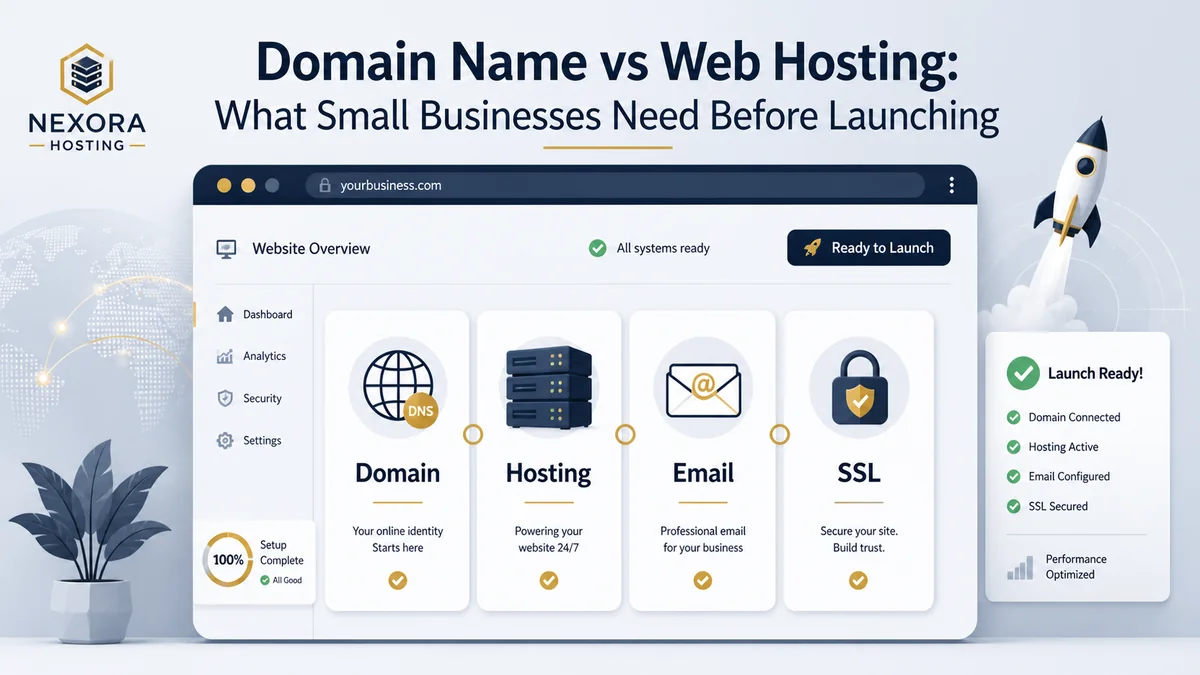
Domain Name vs Web Hosting: What Small Businesses Need Before Launching
August 10, 2026
If you are launching a business website, two terms show up immediately: domain name and web hosting. They are related, but they are not the same thing. Your domain is the address customers type in. Your hosting is where the website files, database, images, and applications actually live.
Getting this right early prevents common launch problems: a domain that points nowhere, email that does not match your brand, an insecure site without SSL, or a hosting plan that cannot handle real traffic. This guide explains the difference in plain English and gives small businesses a practical launch checklist.
What is a domain name?
A domain name is your website address, such as example.com. It is the human-friendly name that points visitors to the correct server. Domain registration reserves that name for your business, but it does not automatically create a website, store your files, or set up professional email.
For a new business, the domain decision matters because it affects branding, trust, search visibility, and email. A short, memorable domain is easier to advertise and easier for customers to recognize in an inbox.
If you still need a business address, start with domain registration and hosting so your domain can be connected cleanly to the rest of your web stack.
What is web hosting?
Web hosting is the service that stores and serves your website. When someone visits your domain, DNS points the browser to your hosting account, and the hosting server sends back the site files, database content, scripts, and media that create the page.
Good hosting is not only storage. It affects page speed, uptime, security, backups, scalability, and support. A small business website may start simple, but it still needs reliable infrastructure so visitors can reach it when they are ready to buy, book, call, or request a quote.
For most small businesses, a strong starting point is reliable web hosting with SSL, email options, support, and room to grow.
Domain name vs web hosting: the simple difference
Think of the domain as your street address and hosting as the building at that address. The address helps people find you, but the building is where the business actually operates.
- Domain name: the address people type into a browser.
- DNS: the routing system that tells browsers where the domain should go.
- Web hosting: the server space and platform that runs your website.
- Email hosting: the mail service that lets you use addresses like hello@yourdomain.com.
- SSL: the certificate that enables HTTPS and helps protect visitors.
You usually need all of these pieces for a professional launch. Buying only a domain means you own the address, but there may be no website. Buying hosting without connecting a domain means the site exists but customers may not know how to find it.
Does domain registration include hosting or email?
Sometimes a provider bundles domain registration, web hosting, and email together, but they are still separate services behind the scenes. This is why searches like "does domain hosting include email" and "does web hosting include email" are so common. The answer depends on the plan.
Before you buy, check whether your package includes:
- Website hosting for your site files and CMS.
- DNS management so the domain can point to your website and email.
- Professional email hosting for branded inboxes.
- SSL certificates for secure HTTPS pages.
- Backups and support if something breaks after launch.
If email is important for trust and sales, connect your domain to professional email hosting instead of relying on a free personal mailbox.
Should you buy your domain and hosting together?
For many small businesses, buying them together is simpler because setup, DNS, SSL, and support are handled in one place. It reduces the chance of pointing records to the wrong server or waiting days to diagnose a launch issue.
However, you can register a domain with one company and host elsewhere if you know how to manage DNS records. The right choice depends on how much control you want and how comfortable you are with technical setup.
Buying together is usually best when:
- You want a fast, low-friction launch.
- You need support for DNS, hosting, email, and SSL in one place.
- You are launching your first business website.
- You want fewer accounts and fewer renewal dates to manage.
Buying separately can make sense when:
- You already own your domain and do not want to transfer it yet.
- You have technical support managing DNS for you.
- You need advanced registrar features from a specific provider.
Small business launch checklist
Use this checklist before your site goes live:
- Choose a short, brandable domain name.
- Register the domain under an account your business controls.
- Select hosting that fits your site type: brochure site, ecommerce, WordPress, or custom app.
- Point DNS records to the correct hosting server.
- Set up branded email addresses for customer communication.
- Install SSL so the site loads over HTTPS.
- Test the home page, contact form, checkout, and mobile layout.
- Confirm backups and support are available before launch day.
If your site will run on WordPress, choose hosting built for WordPress performance, plugin compatibility, and security updates. SleekWeb also offers WordPress hosting for businesses that want a CMS-friendly path.
When basic hosting is enough, and when to upgrade
Shared or standard web hosting is usually enough for a brochure website, landing page, small portfolio, or early-stage business site. As traffic grows, or when your site handles heavier workloads, you may need more scalable resources.
Consider cloud hosting if you expect fluctuating traffic, want easier scaling, or need stronger resource isolation than a basic plan. Consider VPS hosting when you need more server control, custom software, or dedicated resources for a heavier application.
FAQ
Can I have a domain name without hosting?
Yes. You can register a domain and hold it without building a website immediately. To make the domain show a real website, you need hosting or another web platform connected through DNS.
Can I have hosting without a domain?
Yes, but it is not ideal for a public business website. Hosting may provide a temporary URL, but customers should use a branded domain that is easier to trust and remember.
Does web hosting include email?
Some web hosting plans include email, while others treat it as an add-on. Always check mailbox limits, spam filtering, storage, and whether the email uses your business domain.
Do I need SSL if I am not selling products online?
Yes. SSL protects visitor connections, enables HTTPS, and supports trust in browsers. It is important even for basic contact forms and service websites. See SSL security options before launching.
Bottom line
Your domain name is your address. Your web hosting is the place where your website runs. Email, DNS, and SSL complete the professional setup. For a small business launch, the safest approach is to plan these pieces together so customers can find you, trust you, and contact you without technical friction.